Understanding Casting: Principles and Processes
Casting is a manufacturing process where liquid material, typically metal, is poured into a mold, which contains a hollow cavity of the desired shape, and then allowed to solidify. Once the metal cools and hardens, the part, known as a casting, is removed from the mold. This method is celebrated for its ability to create complex geometries, including internal cavities and intricate details, often in a single step.
The fundamental principle behind casting is the phase change of a material from liquid to solid within a predefined form. This process leverages the fluidity of molten metal to fill intricate mold cavities, resulting in components that closely resemble the final desired shape, often requiring minimal post-processing. While seemingly straightforward, the success of casting hinges on a meticulous understanding of metallurgy, fluid dynamics, and heat transfer.
Several primary casting methods are employed across various industries, each suited to different materials, production volumes, and part complexities:
- Sand Casting: This is one of the oldest and most versatile casting processes. It uses expendable molds made from sand, binder, and water. Sand casting is highly flexible for producing large, complex parts in low to medium volumes, and it can accommodate a wide range of ferrous and non-ferrous metals. Its affordability for tooling makes it attractive for prototypes and short production runs, though surface finish and dimensional accuracy might be less precise than other methods.
- Die Casting: Distinguished by its use of reusable metal molds (dies), die casting involves forcing molten metal under high pressure into the mold cavity. This method is ideal for high-volume production of small to medium-sized non-ferrous metal parts, offering excellent dimensional accuracy, smooth surface finishes, and the ability to produce thin walls. However, the initial tooling cost for dies is significantly higher, limiting its economic viability for lower production volumes.
- Investment Casting (Lost-Wax Casting): Renowned for its ability to produce parts with exceptional detail, intricate shapes, and superior surface finish, investment casting uses an expendable wax pattern coated in a ceramic slurry to create the mold. Once the ceramic hardens, the wax is melted out, leaving a precise cavity. This process is often chosen for high-value components in aerospace, medical, and automotive industries where tight tolerances and complex geometries are critical.
- Permanent Mold Casting: Similar to die casting in its use of reusable molds, permanent mold casting typically employs gravity or low pressure to fill the mold cavity. It’s suitable for producing medium to high volumes of non-ferrous parts with good surface finish and mechanical properties, bridging the gap between sand casting and die casting in terms of cost and precision.
- Centrifugal Casting: In this method, molten metal is poured into a spinning mold, and centrifugal force distributes the metal evenly against the mold wall, forming a hollow, cylindrical part. This technique is excellent for producing pipes, tubes, and other rotationally symmetrical components with dense, high-integrity structures, as impurities are forced to the center where they can be machined away.
The advantages of casting include its capability to produce very complex shapes, often consolidating multiple components into a single part, thereby reducing assembly costs. It is generally more cost-effective for large and intricate parts, especially when material removal by machining would be extensive or impossible. Casting also allows for a wide range of alloys to be processed, accommodating various material property requirements. However, potential drawbacks include the possibility of internal defects such as porosity, shrinkage cavities, and inclusions, which can compromise mechanical integrity. The uncontrolled solidification process can lead to a less refined grain structure compared to forged parts, potentially resulting in lower strength, ductility, and fatigue resistance.
Understanding Forging: Principles and Processes
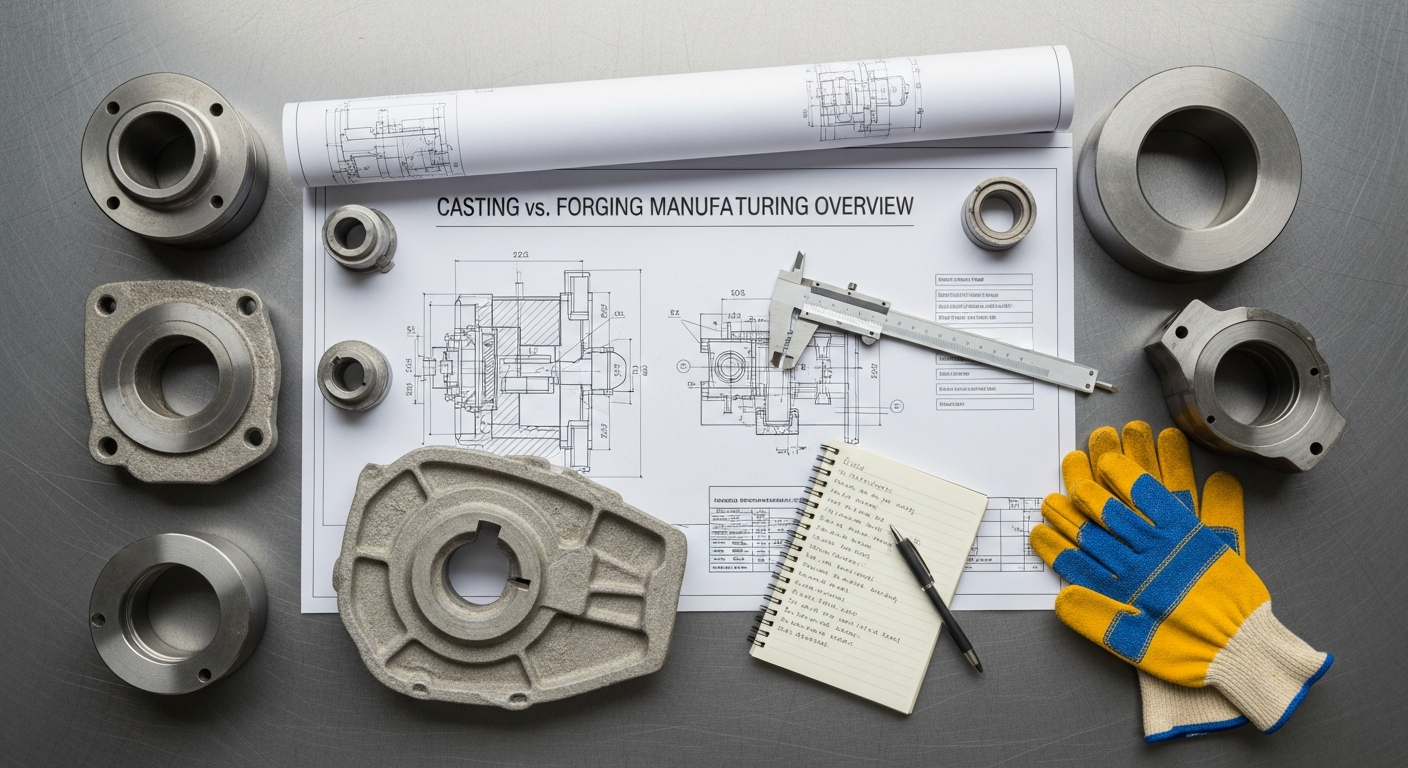
Forging is a manufacturing process involving the shaping of metal using localized compressive forces. Unlike casting, where metal is melted and poured, forging works with solid metal, deforming it mechanically through hammers, presses, or roll machines. This ancient technique, practiced by blacksmiths for centuries, has evolved into a highly sophisticated industrial process capable of producing components with superior strength and structural integrity.
The core principle of forging is the controlled plastic deformation of metal. By applying immense pressure, the metal’s grain structure is refined and elongated, following the contour of the part. This process eliminates internal voids and defects, resulting in a denser, more uniform structure with enhanced mechanical properties in specific directions. The metallurgical benefits of forging are profound, often leading to parts that are stronger, tougher, and more resistant to fatigue than their cast counterparts.
Key forging methods include:
- Open-Die Forging: Also known as blacksmith forging, this method involves shaping metal between multiple blows of a hammer or press, without completely restricting the flow of metal. The dies are typically flat or simple shapes, allowing the operator to manipulate the workpiece to achieve the desired form. Open-die forging is ideal for large, heavy parts, custom shapes, and low-volume production. It’s excellent for improving grain flow and reducing porosity in billets before further processing.
- Closed-Die Forging (Impression-Die Forging): In this more complex process, the metal is placed within dies that contain the desired shape, and pressure is applied to force the metal to fill the die cavities. Excess metal squeezes out of the die cavities to form “flash,” which is later trimmed. Closed-die forging produces parts with high dimensional accuracy, excellent surface finish, and superior mechanical properties due to the controlled grain flow. It’s suitable for medium to high-volume production of complex parts like connecting rods, crankshafts, and gears.
- Roll Forging: This process uses opposing rollers to continuously deform and elongate the workpiece, often reducing its cross-sectional area and increasing its length. It’s particularly efficient for producing long, slender parts, and it can pre-form material for subsequent closed-die forging operations, reducing material waste and energy consumption.
- Upset Forging: In upset forging, the cross-section of a metal bar or rod is increased by applying compressive force along its longitudinal axis. This method is commonly used to produce fasteners like bolts and rivets, where the head is formed by upsetting the end of a rod. It’s efficient for creating parts with concentrated mass in specific areas.
- Press Forging: Utilizes hydraulic or mechanical presses to apply a continuous, slower squeezing action to deform the metal. This allows for deeper penetration of the forging forces into the workpiece, resulting in more uniform deformation throughout the material. Press forging is suitable for larger parts and materials that require more time to deform.
- Hammer Forging: Employs a series of rapid, discrete blows from a hammer to deform the metal. This method is effective for smaller parts and for achieving complex shapes with good material flow.
The primary advantages of forging include the significant improvement in the metal’s mechanical properties. The grain refinement and controlled grain flow impart exceptional strength, toughness, ductility, and fatigue resistance. Forged parts are also less prone to internal defects like porosity and shrinkage, as the intense pressure effectively welds voids shut. This makes forging the preferred choice for critical applications where reliability and structural integrity are paramount, such as in aerospace, automotive powertrains, and heavy industrial machinery. However, forging is typically limited to simpler geometries compared to casting, and creating intricate internal features can be challenging or impossible. Tooling costs for complex closed-die forging can be high, and material waste in the form of flash needs to be managed, though advancements in near-net shape forging are continually reducing this.
Key Differences: Material Properties and Performance
Grain Structure: The Foundation of Strength
- Casting: When molten metal solidifies in a mold, it typically forms a random, non-directional grain structure. As the metal cools, grains nucleate at the mold walls and grow inwards, often resulting in larger, columnar grains. While this structure can be strong, it lacks the uniformity and directional alignment that contributes to superior mechanical properties. There can also be variations in grain size and distribution throughout the part, particularly in thicker sections, which can lead to areas of differing strength and potential weaknesses.
- Forging: In contrast, forging mechanically deforms solid metal, causing the grains to elongate and align along the direction of the metal flow. This process, known as grain flow, refines the grain structure, making it more uniform and dense. Crucially, the aligned grain flow enhances the material’s strength, ductility, and resistance to fatigue in the direction of the flow, providing anisotropic properties that can be strategically leveraged by designers. This intentional orientation of the grain structure is a hallmark of forged components.
Mechanical Properties: Strength, Toughness, and Fatigue Resistance
- Tensile Strength and Yield Strength: Forged parts generally exhibit higher tensile strength and yield strength compared to cast parts made from the same alloy. The refined and aligned grain structure in forged components allows them to withstand greater loads before deforming or fracturing. The compressive forces applied during forging eliminate internal voids and reduce micro-porosity, which are common stress concentrators in castings.
- Ductility and Toughness: Forging significantly improves a metal’s ductility (ability to deform plastically without fracturing) and toughness (ability to absorb energy and resist fracture). The refined grain structure and absence of internal defects make forged materials more resilient to impact and dynamic loads. Castings, with their potentially coarser and less uniform grain structure, can be more brittle and susceptible to sudden fracture, especially under impact or cyclic loading.
- Fatigue Resistance: Components subjected to repetitive loading cycles, such as shafts, gears, and connecting rods, benefit immensely from the enhanced fatigue resistance of forged parts. The smooth, uninterrupted grain flow in forged components minimizes stress concentrations that can initiate fatigue cracks. Castings, with their potential for internal defects and less uniform microstructure, are generally more prone to fatigue failure.
- Impact Resistance: The superior toughness of forged metals translates directly into higher impact resistance. This is critical for parts that might experience sudden shocks or blows, making forging the preferred choice for safety-critical components in vehicles, machinery, and defense applications.
Internal Defects and Homogeneity:
- Casting: The solidification process in casting can lead to various internal defects such as porosity (small gas bubbles), shrinkage cavities (voids formed during solidification), and inclusions (non-metallic foreign particles). While advanced casting techniques and stringent quality control can minimize these, they remain inherent risks that can compromise the structural integrity.
- Forging: The intense compressive forces applied during forging effectively close up internal voids and porosity, consolidating the material into a denser, more homogeneous structure. This results in components with significantly fewer internal defects and a more uniform distribution of material properties.
To accurately predict and validate the performance of components manufactured by either method, advanced engineering tools are indispensable. Finite Element Analysis (FEA) Explained, for instance, provides engineers with the capability to simulate how a part will react to various forces, temperatures, and environmental conditions. For cast parts, FEA can help identify potential stress concentrations around porosity or shrinkage, optimizing mold designs to mitigate these issues. For forged parts, FEA is crucial in understanding the directional properties imparted by grain flow, ensuring that the component is oriented and designed to leverage its anisotropic strengths effectively under operational loads. This predictive power allows for iterative design improvements and helps in selecting the most appropriate manufacturing process for specific performance criteria, ensuring that the final product meets the stringent demands of its application in 2026.
Cost Implications and Production Efficiency
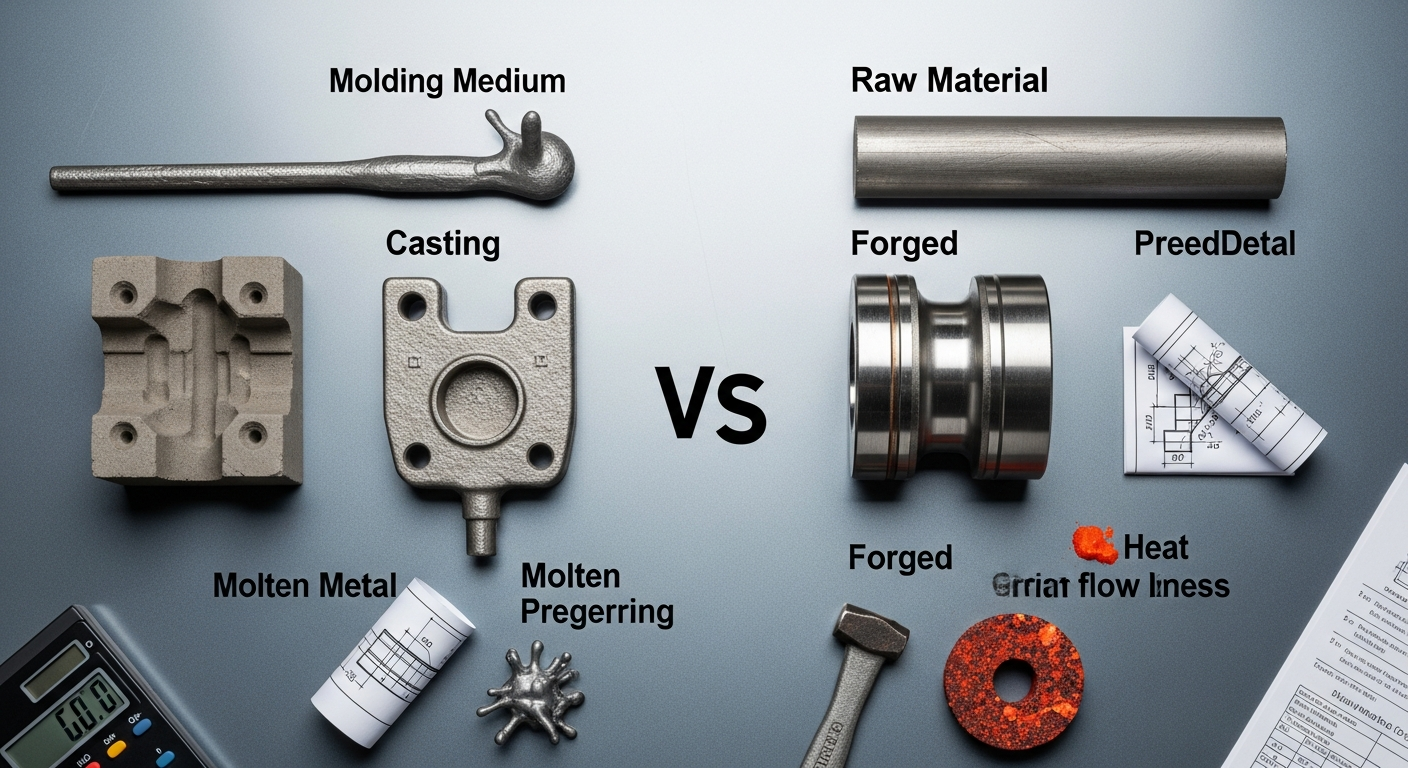
When choosing between casting and forging, the financial implications and overall production efficiency are paramount considerations. These factors encompass everything from initial tooling investments and material utilization to labor costs and cycle times. A comprehensive understanding allows manufacturers like Mitsubishi to optimize their supply chain and product costing.
Tooling Costs:
- Casting: Tooling costs for casting vary significantly depending on the method. Sand casting molds are relatively inexpensive and can be produced quickly, making them economical for low-volume production and prototypes. However, permanent molds used in die casting or permanent mold casting are precision-machined from high-grade steel and can be very expensive, often reaching tens of thousands or even hundreds of thousands of dollars. Despite the high initial investment, these durable dies can produce hundreds of thousands of parts, making them cost-effective for high-volume runs over their lifespan. Investment casting also involves relatively high tooling costs for the wax patterns and ceramic shells, though less than complex die casting dies.
- Forging: Forging dies, particularly for closed-die forging, are also precision-machined from robust die steels and must withstand immense forces and high temperatures. Their cost can be comparable to, or even exceed, that of permanent casting molds. Open-die forging, on the other hand, uses simpler, more generic dies, significantly reducing tooling costs for very large or custom parts. The complexity of the part directly correlates with die complexity and cost for both methods.
Material Utilization and Waste:
- Casting: Casting inherently involves generating some waste. Sprues, risers, and gates are necessary channels for molten metal flow and feeding shrinkage, but they must be removed and often remelted, incurring energy costs. While most of this material can be recycled in-house, it still represents an energy expenditure and process step. Near-net shape casting aims to minimize the amount of excess material, reducing both waste and subsequent machining.
- Forging: Forging also generates waste in the form of “flash,” the excess metal that squeezes out of the die cavities in closed-die forging. This flash must be trimmed and typically recycled. However, modern forging techniques, including precision forging and near-net shape forging, are designed to minimize flash, sometimes eliminating it entirely. This reduces material waste and subsequent machining operations, contributing to more efficient material utilization. The initial stock material for forging typically needs to be of higher quality and purity than for casting, which can influence raw material costs.
Machining Requirements:
- Casting: Due to potential variations in dimensional accuracy, surface finish, and the presence of sprues/risers, cast parts often require more extensive post-casting machining to achieve final tolerances and desired surface quality.
- Forging: Forged parts, especially those produced via precision or closed-die forging, can achieve very tight tolerances and good surface finishes, often requiring less machining than cast parts. This can lead to significant cost savings in machining time, tools, and labor.
Labor and Energy Costs:
- Casting: Modern casting operations are highly automated, particularly die casting, reducing direct labor costs per unit. However, energy consumption for melting large volumes of metal can be substantial.
- Forging: Forging operations also benefit from automation, especially in high-volume press forging. However, the energy required to heat the metal to forging temperature and the power consumption of forging presses can be significant.
Production Volume and Cycle Time:
- Casting: Die casting offers very fast cycle times and is highly efficient for mass production. Sand casting has slower cycle times due to mold preparation and cooling, making it better suited for lower volumes. Investment casting also has longer cycle times due to its multi-step mold creation process.
- Forging: Hammer forging can be fast, but press forging, while slower in terms of individual strokes, often achieves the desired shape in fewer steps, leading to efficient cycle times for high-volume production.
To optimize these cost implications and enhance overall production efficiency, manufacturers are increasingly adopting Manufacturing Waste Reduction Strategies. For casting, this involves optimizing gating and riser systems to minimize material usage, improving mold design to reduce defects that lead to scrap, and implementing energy-efficient melting and holding furnaces. For forging, strategies include using near-net shape forging to reduce flash, optimizing die design to extend tool life, and employing advanced heating methods to minimize energy consumption. By meticulously analyzing each step of the manufacturing process, from raw material procurement to final machining, companies can identify opportunities to eliminate non-value-added activities and resources, thereby lowering costs and improving their competitive edge in 2026.
Design Flexibility and Geometric Complexity
The choice between casting and forging profoundly impacts the design freedom available to engineers and the geometric complexity that can be achieved in a manufactured part. Each process presents unique capabilities and limitations in forming intricate features, internal passages, and varying wall thicknesses.
Casting: The Champion of Complexity
Casting, by its very nature of pouring liquid metal into a mold, offers unparalleled design flexibility, especially for complex geometries. This makes it the go-to process when parts require:
- Intricate Internal Features and Passages: Casting excels at creating internal channels, cavities, and hollow sections that would be impossible or prohibitively expensive to machine. For example, engine blocks with their complex oil and coolant passages are almost exclusively cast. Cores (sand or metal inserts placed in the mold) allow for the formation of these internal features, which can then be removed after solidification.
- Complex External Shapes: Multi-dimensional curves, bosses, ribs, and decorative elements can be easily incorporated into a cast design. The molten metal flows into every crevice of the mold, accurately reproducing the mold’s contours.
- Varying Wall Thicknesses: While engineers must consider solidification patterns to avoid defects, casting generally allows for variations in wall thickness within a single part, provided proper design principles (e.g., avoiding abrupt changes, using fillets) are followed.
- Consolidation of Multiple Parts: Casting can often combine several smaller components into a single, integrated part, reducing assembly operations, potential leak paths, and the overall bill of materials. This not only simplifies manufacturing but also often enhances structural integrity by eliminating joints.
- Near-Net Shape Capabilities: While post-casting machining is often required, advanced casting methods like investment casting can produce parts very close to the final desired shape, minimizing material removal.
However, the pursuit of extreme complexity in casting can introduce challenges, such as ensuring complete mold filling, preventing hot tears, and managing solidification shrinkage to avoid internal voids. Thin walls can be challenging to cast consistently without defects, and achieving extremely tight dimensional tolerances often requires secondary machining operations.
Forging: Strength Over Intricacy
Forging, which relies on plastic deformation of solid metal, is inherently more limited in the geometric complexity it can achieve compared to casting. Its strengths lie in producing robust, high-performance parts with optimized material properties, rather than intricate shapes. Key aspects of forging’s design flexibility include:
- Simpler Geometries: Forging is best suited for parts with relatively simpler external shapes, typically characterized by solid structures, symmetrical forms, and gradual changes in cross-section. Examples include shafts, rings, levers, and connecting rods.
- Absence of Internal Cavities: Creating internal passages or complex hollow sections is generally not feasible with conventional forging. If internal features are required, they usually need to be machined in a secondary operation, which can be costly and time-consuming.
- Draft Angles: Forging dies require draft angles (tapered sides) to allow the forged part to be easily removed from the die without sticking or damaging the part. This requirement limits the ability to create perfectly vertical walls or undercuts.
- Flash Line Considerations: In closed-die forging, a flash line where excess material escapes the die is an inherent feature. Designers must account for this line, often locating it in non-critical areas, as it requires trimming and can sometimes affect aesthetics or performance if not properly managed.
- Near-Net Shape Potential: While traditionally requiring more machining than advanced casting methods, modern precision forging techniques are increasingly capable of producing parts closer to the final dimensions, reducing the need for extensive post-forging machining. This is particularly true for high-volume parts where die design can be optimized.
Despite these limitations, the design freedom in forging is not entirely absent. Engineers can strategically utilize grain flow to enhance the strength of a part in specific directions, optimizing its performance under stress. The ability to create parts with superior strength-to-weight ratios often outweighs the geometric constraints for critical applications. The choice of forging method also influences complexity; open-die forging allows for more custom, often larger, shapes but with less precision, while closed-die forging offers higher precision for defined, repeatable forms.
Ultimately, the decision regarding design flexibility boils down to the primary requirements of the component. If intricate internal passages or highly complex external forms are essential, casting often provides the most direct and cost-effective solution. If superior mechanical properties, high strength, and resistance to fatigue are paramount, even at the expense of geometric simplicity, forging is the preferred method. In some cases, a hybrid approach might be considered, such as casting a complex core and then forging around it, although such methods are specialized and often cost-intensive.
Applications Across Industries
The distinct advantages and limitations of casting and forging dictate their preferential use across a wide spectrum of industries. Understanding these application trends helps clarify why specific components are manufactured using one method over the other.
Casting Applications:
Casting is favored for its ability to produce complex, often large, components with internal features, making it indispensable in industries where intricate shapes and cost-effectiveness for certain volumes are key. It is particularly prevalent in:
- Automotive Industry:
- Engine Blocks and Cylinder Heads: These are classic examples of cast parts, requiring complex internal passages for coolant, oil, and exhaust gases, which would be impossible or prohibitively expensive to machine from solid metal. Grey iron and aluminum alloys are commonly used.
- Transmission Housings: Often complex, multi-chambered components that benefit from the geometric freedom of casting to integrate various mounting points and fluid pathways.
- Brake Calipers and Master Cylinders: Require intricate internal channels for hydraulic fluid, making casting an ideal choice.
- Intake Manifolds: Complex air routing benefits from casting’s ability to create convoluted shapes.
- Heavy Machinery and Industrial Equipment:
- Pump Housings and Valve Bodies: Components that manage fluid flow often have complex internal geometries that are best achieved through casting.
- Machine Bases and Frames: Large, intricate structures for stability and component integration are frequently cast from iron or steel.
- Gearboxes and Differential Housings: Complex internal structures to house gears and bearings.
- Aerospace Industry (Specialized Castings):
- While forging dominates for highly critical structural components, investment casting is used for specific aerospace parts, especially those made from superalloys, where extremely intricate shapes, thin walls, and high-temperature performance are required (e.g., turbine blades and vanes in jet engines).
- Consumer Goods and Decorative Items:
- From plumbing fixtures to intricate statues and artistic pieces, casting allows for detailed aesthetic designs.
- Construction:
- Pipe fittings, manhole covers, and various structural connectors.
Forging Applications:
Forging is chosen for applications demanding superior strength, toughness, and fatigue resistance, particularly in components subjected to high stresses, impacts, or cyclic loading. Industries that rely heavily on forged parts include:
- Automotive Industry:
- Crankshafts and Connecting Rods: Critical components in an engine’s powertrain that endure immense cyclic stresses. Forging provides the necessary strength and fatigue resistance.
- Gears: Forged gears have superior strength and wear resistance due to their refined grain structure, making them ideal for transmissions and differentials.
- Axle Shafts and Wheel Hubs: Components that transmit power and support vehicle weight, requiring high strength and impact resistance.
- Steering Knuckles: Safety-critical components that connect the wheel to the suspension system.
- Aerospace Industry:
- Landing Gear Components: Subjected to extreme impact loads during landing, forging is essential for their structural integrity and reliability.
- Turbine Discs and Blades (Rotor): While vanes are often cast, rotating turbine components are often forged for their exceptional strength and resistance to high-temperature creep and fatigue.
- Structural Airframe Components: Forged bulkheads, spars, and brackets ensure the structural integrity of the aircraft.
- Oil & Gas and Energy Sector:
- Valve Bodies and Fittings (High Pressure): For high-pressure, high-temperature applications where material integrity is paramount to prevent leaks and failures.
- Drill Bits and Downhole Tools: Components that endure extreme abrasive wear and impact forces.
- Wind Turbine Shafts and Gear Blanks: Large, critical components for renewable energy infrastructure.
- Heavy Machinery and Industrial Equipment:
- Heavy-Duty Gears and Sprockets: For construction, mining, and agricultural equipment, where durability and load-bearing capacity are crucial.
- Industrial Hooks and Chains: Components designed for lifting and pulling heavy loads.
- Railway Wheels and Axles: Subjected to continuous heavy loads and impacts.
- Defense and Military:
- Components for weaponry, armored vehicles, and naval vessels where reliability under extreme conditions is non-negotiable.
The clear distinction in applications highlights that the choice between casting and forging is rarely arbitrary. It is a strategic decision driven by the specific performance requirements, the economic constraints of production volume, and the inherent capabilities of each manufacturing process. As Mitsubishi Manufacturing continues to innovate, selecting the optimal process ensures that our components not only meet but exceed the rigorous demands of their intended service in a rapidly advancing global market in 2026.
Making the Right Choice: Strategic Considerations for Mitsubishi Manufacturing
The decision to employ casting or forging for a specific component is a critical strategic consideration that directly impacts product performance, manufacturing costs, and market competitiveness. At Mitsubishi Manufacturing, our approach is always holistic, weighing various technical and economic factors to select the optimal process for each unique application. There is no universally “better” method; rather, there is a most appropriate method based on a detailed analysis of requirements.
Here are the key strategic considerations that guide our decision-making process:
- Component Performance Requirements:
- Strength and Toughness: If the component will be subjected to high stresses, impact loads, fatigue cycling, or needs exceptional reliability in critical applications (e.g., aerospace, automotive powertrains), forging is typically the preferred choice due to its superior mechanical properties and refined grain structure.
- Ductility: For parts that need to withstand significant plastic deformation without fracture, forging generally offers higher ductility.
- Wear Resistance: Forged components often exhibit better wear resistance due to their dense, uniform microstructure.
- Environmental Factors: Consider operating temperatures, corrosive environments, and other service conditions that might influence material degradation.
- Geometric Complexity and Design Freedom:
- Intricate Shapes and Internal Passages: If the part requires complex internal cavities, thin walls, or highly intricate external features that consolidate multiple functions, casting offers superior design flexibility.
- Simpler, Robust Forms: For parts with relatively simpler, solid geometries where structural integrity is paramount, forging is more suitable.
- Tolerances and Surface Finish: While both can achieve good results, investment casting can produce excellent surface finish and tight tolerances, as can precision forging. The need for minimal post-processing often influences the choice.
- Material Selection:
- Both processes can handle a wide range of ferrous and non-ferrous metals. However, some alloys are more amenable to one process than the other. For instance, certain high-strength superalloys are difficult to forge into complex shapes but can be investment cast. Conversely, some alloys achieve their peak performance only after forging.
- Consider the material’s cost and availability in the form suitable for casting (ingots) or forging (billets/bars).
- Production Volume and Economic Viability:
- Low Volume/Prototypes: For low-volume production or initial prototypes, sand casting and open-die forging might be more economical due to lower tooling costs.
- Medium to High Volume: Die casting, permanent mold casting, and closed-die forging become highly competitive and cost-effective at medium to high production volumes, as the initial tooling investment is amortized over many units.
- Total Cost of Ownership: This includes raw material, tooling, labor, energy, post-processing (machining, heat treatment), inspection, and potential scrap rates. A seemingly cheaper initial process might incur higher downstream costs.
- Lead Time and Time-to-Market:
- The time required for tooling design and fabrication can be significant for both high-volume casting and forging. However, the overall cycle time for production runs can vary, impacting time-to-market strategies.
- Sustainability and Environmental Impact:
- Consider energy consumption, material waste, and recyclability. Manufacturing Waste Reduction Strategies are crucial here. Both processes are increasingly adopting more sustainable practices, from energy-efficient furnaces to advanced material recycling programs.
At Mitsubishi Manufacturing, our strategic decision-making process is deeply intertwined with Lean Manufacturing Principles Explained. A lean approach encourages us to identify and eliminate waste, whether it’s over-processing, excess inventory, defects, or unnecessary motion, throughout the entire product lifecycle. When comparing casting and forging, lean principles guide us to:
- Value Stream Mapping: Analyze the entire value stream for both processes, from raw material to finished
Recommended Resources
Related reading: Breast Health And Mammogram Guide (Protect Families Protect Choices).
Related reading: Benefits Of Meditation For Stress (Diaal News).