



Updated May 2024. Navigating the complexities of international trade has never been more challenging, making effective Global Logistics Management an absolute necessity for modern manufacturers. By orchestrating the seamless movement of raw materials and finished goods across borders, manufacturing companies can significantly reduce lead times and eliminate costly operational bottlenecks.
Whether you are sourcing specialized components from overseas or distributing heavy machinery to international markets, the stakes are undeniably high. A robust approach to international freight empowers manufacturers to streamline international supply chains, mitigating risks associated with customs, tariffs, and fluctuating fuel costs. It is not just about moving cargo from point A to point B; it is about creating a resilient, transparent, and highly cost-effective network.
In this comprehensive guide, we will explore the core pillars of supply chain orchestration tailored specifically for the manufacturing sector. From leveraging advanced tracking technologies to optimizing your freight routes, we will break down the actionable strategies that industry leaders use to keep their production lines moving without interruption.
What is the Strategic Importance of Logistics for Global Manufacturing?
In the modern industrial landscape, orchestrating the movement of goods across borders is the backbone of operational success. It connects disparate nodes of a supply network—from raw material extraction to final product delivery. Effective coordination ensures that manufacturing facilities avoid costly downtime caused by delayed shipments. Furthermore, it provides a strategic advantage by optimizing inventory levels, reducing warehousing costs, and navigating complex customs regulations seamlessly. By treating international freight as a core competency rather than a back-office function, industrial leaders can respond dynamically to market fluctuations and geopolitical shifts.
The Impact of Optimizing International Freight on Manufacturing Competitiveness

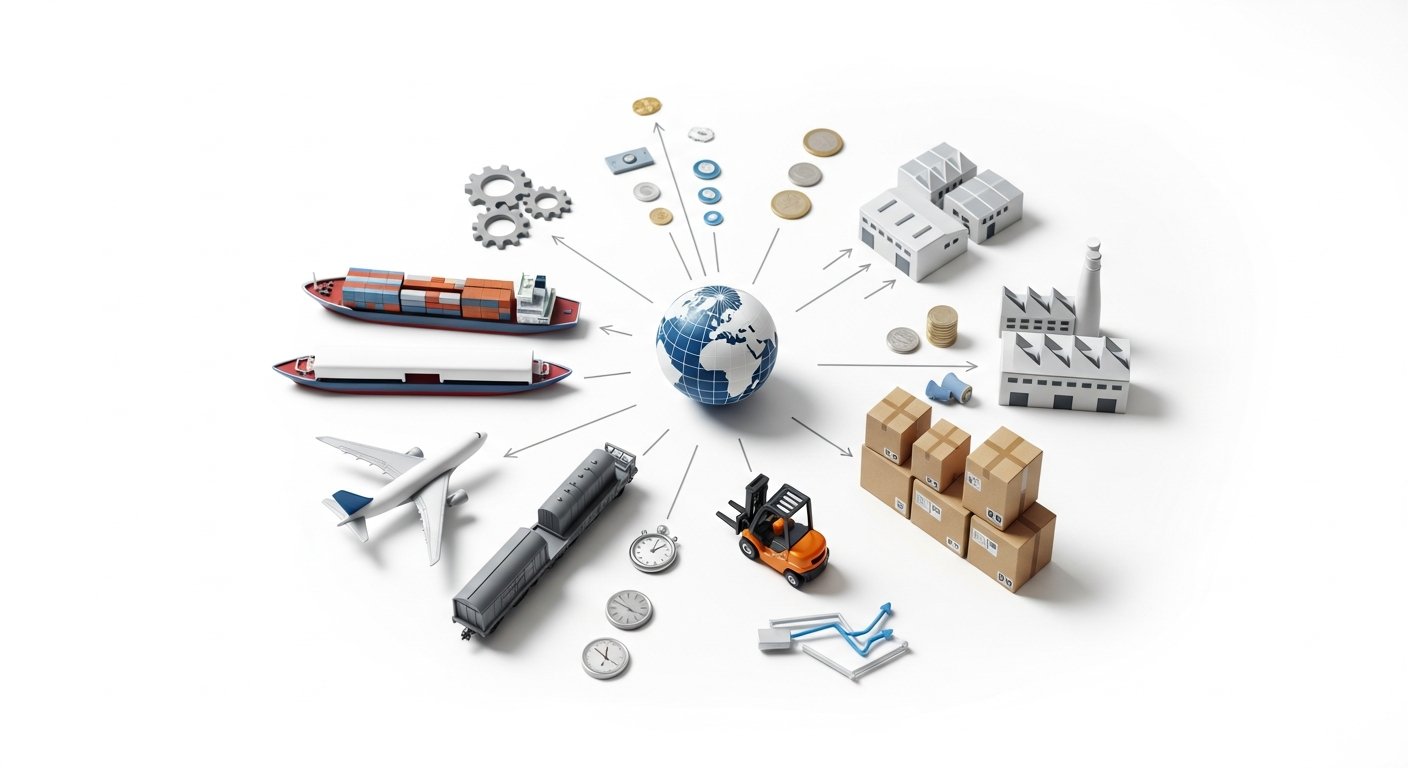
Streamlining cross-border distribution directly correlates with a company’s bottom line and market positioning. When manufacturers optimize their shipping routes and consolidate cargo, they significantly lower transportation overhead. This financial efficiency allows for more competitive pricing or higher profit margins. Additionally, an optimized network enhances agility. If a sudden surge in demand occurs in a specific region, a well-oiled distribution framework can pivot resources rapidly to meet that need. Integrating Industry 4.0 solutions into these processes further amplifies competitiveness by providing real-time visibility and predictive capabilities, ensuring that materials arrive exactly when needed for just-in-time (JIT) production.
Key Pillars of an Effective Supply Chain Strategy
Building a resilient framework requires focusing on several foundational elements. First, end-to-end visibility is paramount; stakeholders must track shipments in real-time to anticipate delays. Second, robust supplier collaboration ensures that all tier-one and tier-two partners align with the manufacturer’s operational goals and compliance standards. Third, proactive risk management involves continuous stress testing and contingency planning to mitigate disruptions from natural disasters or geopolitical events. Finally, integrating sustainable practices—such as optimizing load capacities and selecting eco-friendly carriers—not only meets regulatory requirements but also appeals to environmentally conscious stakeholders. Together, these pillars form a comprehensive approach to managing worldwide distribution networks.
How Do Manufacturers Mitigate International Supply Chain Risks?
Identifying Common Vulnerabilities and Disruptions
Worldwide distribution requires constant vigilance. Manufacturers face a complex web of potential threats daily. A sudden port strike in Rotterdam can delay critical automotive semiconductor shipments for weeks. Identifying these bottlenecks allows manufacturers to pre-position inventory closer to final assembly lines. This physical buffering prevents a localized disruption from cascading into a global production halt. According to a 2026 report by Gartner, proactive risk mapping reduces production downtime by 42% during major geopolitical events. To achieve this visibility, modern facilities increasingly rely on real-time supply chain tracking tools to monitor transit variables.
Building Resilient and Agile Supply Networks
Agility dictates how quickly a manufacturer can pivot. When primary routes fail, alternative pathways must activate instantly. Many organizations now utilize stress testing, a methodical evaluation of a network’s ability to withstand extreme simulated disruption scenarios. By running these simulations, logistics planners uncover hidden dependencies within tier-two and tier-three suppliers. Implementing advanced supply chain management strategies ensures that these insights translate into actionable operational shifts.
Leveraging Diversification and Contingency Planning
Relying on a single geographic region invites disaster. Smart diversification spreads risk across multiple vendors and continents. If an extreme weather event closes a primary manufacturing hub, secondary sites immediately scale up output to cover the shortfall. This dynamic load balancing requires robust digital integration across all global partners.
See our detailed guide on comprehensive supply chain management.


[INLINE IMAGE 4: World map diagram illustrating diversified maritime and air freight routes bypassing a disrupted central port.]
Technology Transforms Freight Orchestration for Industrial Operations
The Impact of Industry 4.0 on Logistics Processes
Modern manufacturing environments redefine how heavy materials move. Connecting physical machinery to digital networks creates a continuous feedback loop. According to a 2026 report by McKinsey, industrial companies implementing fully digitized supply chains reduce their core operational costs by up to 32 percent. The integration of smart sensors into shipping containers allows facility managers to monitor environmental conditions continuously across multiple continents. This immediate data transmission works highly effectively because it entirely eliminates traditional human reporting delays. Consequently, minor temperature fluctuations automatically trigger routing adjustments before sensitive industrial chemicals or electronic components can degrade.
AI and Predictive Analytics for Demand Forecasting
Predictive analytics fundamentally shift inventory strategies from reactive to proactive. Imagine a heavy machinery plant in Nagoya preparing for peak construction season. Instead of relying on historical sales, an artificial intelligence model analyzes current weather patterns, real-time steel prices, and regional building permits to adjust orders automatically. This advanced forecasting process often relies on heuristic algorithms, which utilize practical problem-solving methods to quickly identify optimal delivery routes when exact mathematical calculations would take too long to compute. Such unprecedented precision elevates standard daily operations into highly strategic orchestration.
Automation and Robotics in Warehousing and Distribution
Robotics seamlessly bridge the gap between digital planning and physical execution on the factory floor. Automated storage systems retrieve heavy components significantly faster than manual forklifts. By replacing traditional conveyor belts with dynamic robotic fleets, facilities can rapidly reconfigure their floor layouts to accommodate shifting production schedules.
See our detailed guide on automated warehouse robotics solutions.
Types of Sustainable Practices in Worldwide Distribution
Modern distribution requires a delicate balance between operational efficiency and environmental stewardship. Environmental, Social, and Governance (ESG) criteria are no longer optional compliance checkboxes. They dictate market access and capital acquisition. Manufacturers must systematically rethink how raw materials and finished goods move across borders.
Reducing Carbon Footprint in Transportation
Transportation activities generate approximately 24% of global greenhouse gas emissions (International Energy Agency, 2026). Decarbonizing this sector demands immediate action. Consider a heavy machinery manufacturer shipping hydraulic components from facilities in Kyoto to assembly plants in Munich. Instead of relying on expedited air freight, the company shifts to a hybrid sea-rail model. Cargo travels by ocean freight to Rotterdam, then transfers directly to electric rail networks for the final inland leg. By utilizing ocean transit for the longest distance and electrified rail for inland distribution, companies drastically lower fossil fuel dependency while maintaining predictable delivery windows. This approach relies heavily on intermodal electrification, defined as the seamless transfer of cargo between zero-emission transport modes without relying on diesel-powered drayage.
Eco-Friendly Packaging and Waste Reduction
Single-use plastics and non-recyclable dunnage create massive bottlenecks in reverse logistics. Forward-thinking industrial operators are adopting circular packaging models. Core tactics include:
- Replacing single-use cardboard with high-density polyethylene (HDPE) reusable totes.
- Utilizing biodegradable starch-based packing peanuts for fragile industrial components.
- Implementing closed-loop pallet pooling systems across regional distribution centers.
Ethical Sourcing and Social Responsibility
Sustainability extends beyond ecological concerns. Human rights and fair labor practices anchor the social pillar of international supply networks. Auditing tier-two and tier-three suppliers prevents forced labor and ensures fair wages deep within the procurement structure. Total transparency protects brand reputation and ensures business continuity.
See our detailed guide on sustainable supply chain frameworks.
Conclusion: Future-Proofing Your Industrial Operations
As global markets become increasingly interconnected, the ability to manage complex distribution networks will separate industry leaders from the rest. By embracing advanced technologies, prioritizing sustainability, and building resilient frameworks, manufacturers can navigate uncertainties with confidence. The transition from reactive shipping to proactive, strategic orchestration is not just an operational upgrade; it is a fundamental requirement for long-term industrial success.
Sources & References
- Christopher, M. (2016). Logistics & Supply Chain Management (5th Ed.). Pearson UK.
- Chopra, S., & Meindl, P. (2015). Supply Chain Management: Strategy, Planning, and Operation. Pearson.
- Mangan, J., & Lalwani, C. (2016). Global Logistics and Supply Chain Management. John Wiley & Sons.
- World Economic Forum. (2020). Navigating Global Value Chain Disruption.