Integrating Collaborative Robots (Cobots) in Industry
In the dynamic landscape of modern industrial manufacturing, the pursuit of efficiency, safety, and adaptability is relentless. Amidst this evolution, a technological innovation stands out: collaborative robots, commonly known as cobots. These advanced systems represent a pivotal shift in industrial automation, specifically engineered to operate safely alongside human personnel within shared workspaces, eliminating the need for extensive safety guarding. Across the diverse spectrum of industrial manufacturing, these systems are fundamentally transforming production lines, boosting flexibility, significantly enhancing safety protocols, and optimizing overall operational efficiency in a myriad of tasks, from intricate precision assembly to critical quality inspection, thereby establishing them as a cornerstone of adaptive and intelligent factories.
What are Collaborative Robots (Cobots) in Industry?
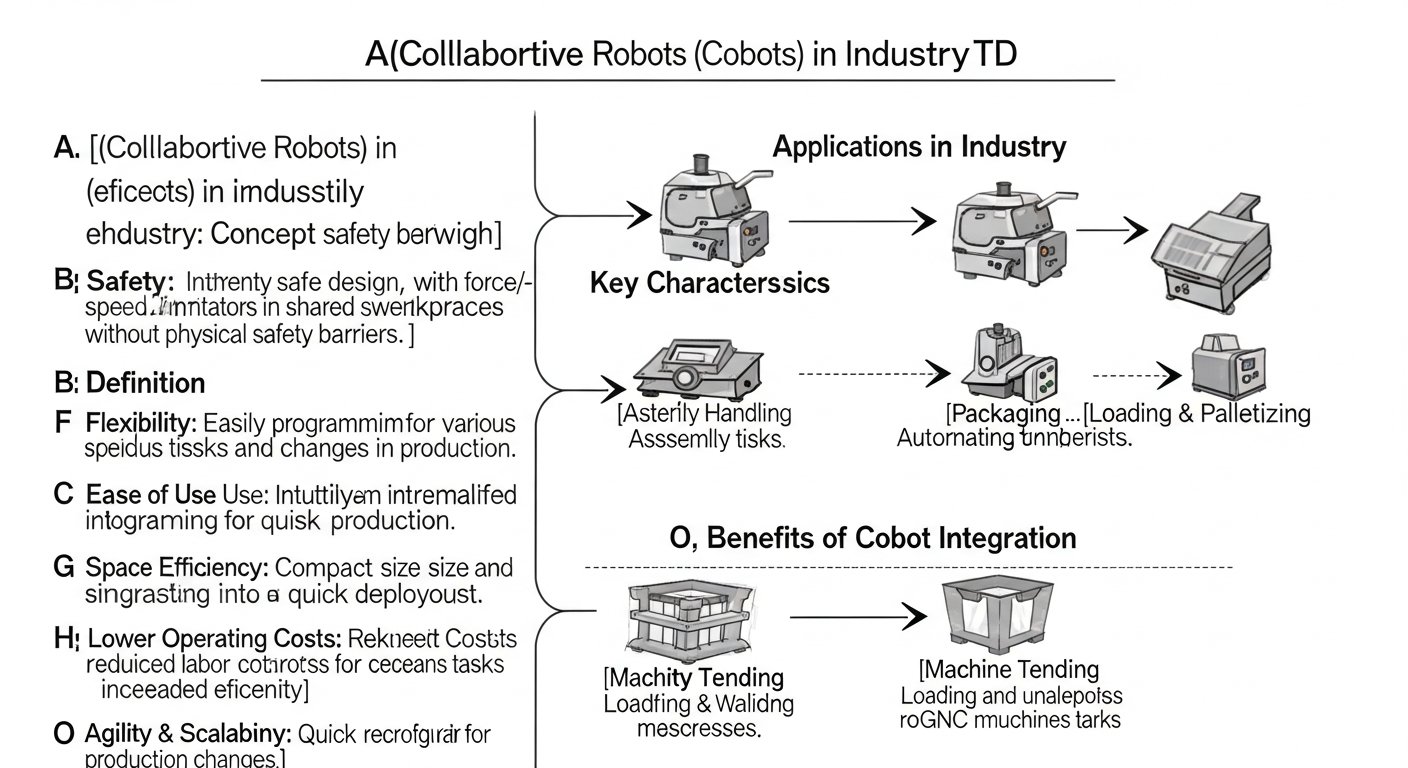
Collaborative robots, or cobots, are a distinct class of robotic systems characterized by their inherent ability to work directly with human operators in a shared environment. Unlike traditional industrial robots, which are typically caged off for safety due to their speed and power, cobots possess built-in safety features that allow them to interact with humans without posing significant risk. These systems are designed to augment human capabilities, taking over repetitive, ergonomically challenging, or dangerous tasks, while humans focus on more complex, value-added activities that require cognitive skills, dexterity, or problem-solving.
The core principle defining these collaborative automation solutions revolves around enhanced human-robot interaction. This interaction is governed by strict international safety standards, notably ISO 10218-1 and the technical specification ISO/TS 15066. These standards delineate four primary types of collaborative operation: Safety-Rated Monitored Stop, Hand Guiding, Speed and Separation Monitoring, and Power and Force Limiting. The latter, in particular, is a hallmark of many cobot designs, where the robot’s power and force are inherently limited, or it features advanced sensor technology that detects collisions and immediately stops or reverses movement to prevent injury.
These industrial cobots are typically characterized by a smaller footprint, lower payload capacity (ranging from a few kilograms up to around 35 kg for some models), and a more intuitive programming interface compared to their traditional counterparts. Their reach, repeatability, and payload capabilities are optimized for a range of tasks that historically required human intervention or complex, expensive automation.
What are the Key Differentiators Between Cobots and Traditional Industrial Robots?
While both collaborative robots and traditional industrial robots serve to automate manufacturing processes, their fundamental design philosophies and operational characteristics diverge significantly. Understanding these differences is crucial for selecting the appropriate automation solution for specific industrial tasks. Traditional industrial robots are engineered for high speed, high payload, and extreme precision in highly structured, often isolated environments. They excel in repetitive, high-volume tasks that demand unwavering consistency and power.
Conversely, cobots prioritize safety, flexibility, and ease of integration into existing human workflows. They are designed for scenarios where human presence is required or beneficial, facilitating a symbiotic relationship rather than a complete replacement of human labor. This distinction impacts everything from installation and programming to operational costs and the overall return on investment (ROI).
| Feature | Collaborative Robots (Cobots) | Traditional Industrial Robots |
|---|---|---|
| Safety Requirements | Designed for safe human-robot collaboration; often no guarding required due to inherent safety features (e.g., force limiting). | Require extensive safety guarding (fences, light curtains) to separate humans due to high speed/power. |
| Workspace | Shared workspace with humans. | Segregated, dedicated workspace, isolated from human operators. |
| Programming Complexity | Relatively easy, often intuitive lead-through programming or graphical user interfaces; quick setup. | Requires specialized programming skills and complex coding; longer setup times. |
| Flexibility/Redeployment | High; easily moved and reprogrammed for different tasks or production lines. | Lower; typically fixed in place, more complex to reconfigure for new tasks. |
| Typical Cost Range (Initial) | Lower to moderate (e.g., $25,000 – $100,000+ per unit). | Higher (e.g., $50,000 – $200,000+ per unit, excluding safety cell). |
| Payload Capacity | Lower (e.g., 0.5 kg to 35 kg). | Higher (e.g., 5 kg to 2,000+ kg). |
| Footprint | Compact, small footprint; designed for tight spaces. | Larger footprint due to robot size and required safety enclosures. |
| Primary Focus | Human-robot collaboration, flexibility, ease of use, small to medium batch production. | High speed, heavy lifting, precision, high-volume mass production. |
What are the Primary Benefits of Cobots in Industrial Manufacturing?
This section delves into the fundamental advantages that make collaborative robots indispensable tools for modern industrial manufacturing, focusing on how they contribute to safety, efficiency, and adaptability across various operational contexts. The deployment of these intelligent systems offers a compelling array of benefits that directly address critical industry challenges, from labor shortages and rising production costs to the increasing demand for customization and shorter product lifecycles. By integrating human-robot collaboration systems, manufacturers can unlock new levels of performance and competitiveness.
The strategic implementation of industrial cobots often translates into a significant return on investment (ROI), primarily driven by their ability to reduce cycle times, improve product quality through consistent execution, and lower operational costs associated with manual labor in repetitive or hazardous roles. Furthermore, their inherent flexibility allows companies to adapt quickly to evolving market demands, making them a cornerstone of agile manufacturing strategies.
How Do Cobots Enhance Safety and Ergonomics on the Factory Floor?
One of the most compelling benefits of human-robot collaboration systems is their profound impact on workplace safety and ergonomics. Traditional industrial settings often expose human workers to repetitive strain injuries, musculoskeletal disorders, and accidents associated with operating heavy machinery or handling dangerous materials. Collaborative automation solutions are specifically engineered to mitigate these risks.
Their integrated safety features, such as force and torque sensors, immediate stop functions upon contact, and limited power output, ensure that they can work in close proximity to humans without requiring physical barriers. This allows cobots to handle tasks that are ergonomically challenging for humans, such as repetitive lifting, twisting, or precise placement over extended periods. By offloading these physically demanding jobs, cobots significantly reduce the incidence of work-related injuries, improve worker well-being, and decrease absenteeism, ultimately contributing to a healthier and more productive workforce.
How Do Cobots Improve Productivity and Operational Efficiency?
The integration of flexible automation in production yields substantial improvements in productivity and operational efficiency across numerous industrial processes. Cobots excel at performing repetitive tasks with high consistency and precision, eliminating the variability and potential for human error inherent in manual operations. This leads to more uniform product quality and reduced rework rates.
For instance, in tasks like machine tending, a cobot can load and unload parts continuously, allowing the machine to operate with minimal downtime, thereby increasing throughput. Their ability to work tirelessly, without breaks or fatigue, ensures consistent cycle times and predictable output. Furthermore, the ease of programming and quick redeployment capabilities of smart manufacturing robots mean that production lines can be rapidly reconfigured to handle different product variations or smaller batch sizes, a critical advantage in today’s highly customized manufacturing environment. This scalability and adaptability allow manufacturers to respond dynamically to fluctuating production schedules and demand peaks, optimizing resource utilization and minimizing bottlenecks.

What are the Real-World Applications of Collaborative Robots Across Industrial Sectors?
The versatility of collaborative automation solutions has led to their widespread adoption across a multitude of industrial sectors, each leveraging their unique capabilities to address specific operational challenges. From precision assembly in electronics to heavy lifting in logistics, these human-robot collaboration systems are proving to be adaptable tools for enhancing various manufacturing and processing tasks. Their ability to integrate seamlessly into existing workflows without extensive reconfigurations makes them an attractive investment for companies looking to boost efficiency and safety without disrupting established operations.
The examples below illustrate how smart manufacturing robots are not just theoretical enablers of Industry 4.0 but practical solutions delivering tangible benefits in diverse environments. Their compact size and intuitive programming open doors for automation in areas previously deemed too complex or costly for traditional industrial robots.
| Industry Sector | Common Cobot Tasks | Primary Benefits Achieved |
|---|---|---|
| Automotive | Assembly (e.g., screw driving, component insertion), quality inspection, material handling, polishing. | Improved precision in assembly, reduced ergonomic strain for workers, enhanced consistency in finishing tasks, increased throughput. |
| Electronics | Printed circuit board (PCB) assembly, precision part insertion, screw driving, testing, pick & place of small components. | High accuracy for delicate components, reduced human error, accelerated production cycles, improved yield rates. |
| Food & Beverage | Packaging, palletizing, pick & place of food items, quality control, food preparation assistance. | Enhanced hygiene, consistent packaging quality, reduced manual labor for repetitive tasks, improved traceability. |
| General Manufacturing | Machine tending (CNC, injection molding), welding, glue dispensing, sanding, material removal. | Increased machine uptime, consistent weld quality, reduced exposure to hazardous processes, improved surface finish. |
| Logistics/Warehousing | Palletizing, depalletizing, sorting, order picking, packaging. | Faster order fulfillment, reduced heavy lifting injuries, optimized space utilization, increased operational speed. |
| Pharmaceuticals | Laboratory automation, sterile handling of materials, quality control, packaging of delicate products. | High precision in lab processes, maintenance of sterile environments, reduced contamination risk, enhanced data collection for compliance. |
How are Collaborative Robots Used in Assembly and Material Handling?
In assembly lines, cobots are invaluable for repetitive and precise tasks such as screw driving, component insertion, and gluing. Their consistent execution ensures uniform quality and reduces the potential for defects that can arise from human fatigue or variability. For instance, in automotive manufacturing, cobots can assist with the intricate assembly of interior components, where precision and careful handling are paramount.
For material handling, industrial cobots excel at pick & place tasks, packaging, and palletizing. These tasks, often characterized by their repetitive and physically demanding nature, are perfectly suited for collaborative automation solutions. By taking over the lifting and moving of items, cobots alleviate physical strain on workers, significantly reducing the risk of musculoskeletal injuries. This not only improves worker safety but also allows human operators to focus on supervisory roles, quality checks, or more intricate aspects of the process.
How Do Cobots Improve Quality Inspection and Machine Tending?
Quality inspection is another area where human-robot collaboration systems are making a significant impact. Equipped with advanced vision systems and sensors, cobots can perform highly accurate and consistent inspections, identifying defects or inconsistencies that might be missed by the human eye during manual checks. This is particularly critical in industries like electronics or medical devices, where even minor flaws can have substantial consequences. Their objective analysis ensures a higher standard of product quality and reduces overall waste.
Machine tending, involving the loading and unloading of parts from CNC machines, injection molding machines, or presses, is a classic application for flexible automation in production. Cobots can tirelessly perform these tasks, ensuring that machines operate continuously with minimal downtime. This boosts machine utilization rates and overall production output. A key advantage here is the cobot’s ability to be deployed right next to the machine without needing extensive safety caging, making automation feasible even in crowded factory layouts.
What Challenges and Considerations Exist for Cobot Integration?
While the benefits of collaborative automation solutions are numerous, their successful integration into an industrial manufacturing environment is not without its challenges. Addressing these considerations proactively is crucial for maximizing ROI and ensuring a smooth transition to enhanced human-robot collaboration. Companies must look beyond the initial attraction of flexibility and ease of programming and delve into the practicalities of implementation, maintenance, and workforce adaptation. Effective planning and a clear understanding of potential hurdles are paramount for any organization embarking on this journey.
Successfully integrating smart manufacturing robots requires a holistic approach that considers not just the technological aspects but also the organizational culture, workforce skills, and long-term strategic goals. Overlooking these elements can lead to suboptimal performance, resistance from employees, and ultimately, a failure to fully realize the transformative potential of these systems.
What are the Technical and Workforce Integration Hurdles for Cobots?
Technical hurdles for collaborative automation solutions can include the initial investment, which, while lower than traditional robots, still requires significant capital planning. Selecting the right sensor technology for specific safety requirements and task precision is critical. Moreover, while programming is generally easier, advanced tasks may still require specialized skills, pointing to a potential skill gap within the existing workforce.
Data integration is another area that demands attention. For cobots to fully contribute to Industry 4.0 and smart factory initiatives, they must seamlessly communicate with other manufacturing execution systems (MES), enterprise resource planning (ERP) systems, and IoT devices. This necessitates robust network infrastructure and cybersecurity measures to protect sensitive production data.
From a workforce perspective, change management is paramount. Employees may harbor fears of job displacement or feel intimidated by new technology. Effective communication, demonstrating how cobots augment rather than replace human workers, is essential. Comprehensive training programs are vital to upskill existing staff, equipping them with the knowledge to program, operate, and maintain these new systems. This transformation creates new roles, such as cobot technicians and automation specialists, which require continuous learning and development.
What are Common Mistakes in Collaborative Robot Implementation?
Companies embarking on cobot integration frequently encounter pitfalls that can hinder their success. One common mistake is neglecting a thorough risk assessment specific to the collaborative environment. Assuming that “cobots are inherently safe” without evaluating the full human-robot interaction in context can lead to safety incidents or underutilized potential. Another error is failing to involve shop floor workers in the planning and implementation phases. Their practical insights are invaluable for identifying the most suitable applications and fostering acceptance.
Underestimating the training required for operators and maintenance staff is also a significant oversight. While cobots are user-friendly, mastering their programming and troubleshooting requires dedicated effort. Furthermore, some organizations make the mistake of deploying cobots on tasks that are either too complex for their current capabilities or too simple to yield significant ROI, leading to disillusionment. Lastly, ignoring the necessary network and data integration for Industry 4.0 benefits means settling for isolated automation rather than a truly connected and intelligent factory.
What are the Steps for Successful Cobot Integration in Your Facility?
- **Conduct a Comprehensive Feasibility Study and Risk Assessment:** Identify specific tasks suitable for cobots (e.g., repetitive, high-volume, ergonomically challenging). Evaluate potential safety risks in shared workspaces according to ISO/TS 15066.
- **Define Clear Objectives and ROI Metrics:** Establish what success looks like (e.g., X% increase in throughput, Y% reduction in injuries, Z months for ROI). This guides selection and measures effectiveness.
- **Select the Right Cobot and End-Effector:** Match the cobot’s payload, reach, speed, and precision capabilities with the chosen application. Research compatible end-effectors (grippers, tools) for the task.
- **Plan for Infrastructure and Integration:** Assess network infrastructure, power requirements, and potential data integration needs with existing MES/ERP systems. Consider physical layout changes.
- **Develop a Phased Implementation Strategy:** Start with a pilot project on a non-critical task to learn and refine the process before scaling up. This minimizes disruption.
- **Invest in Comprehensive Training and Upskilling:** Train operators, maintenance staff, and engineers on programming, operation, safety protocols, and troubleshooting. Address skill gaps proactively.
- **Establish Robust Change Management and Communication:** Involve employees early, communicate benefits, address concerns, and highlight new opportunities for skill development and improved work conditions.
- **Monitor Performance and Iterate:** Continuously track key performance indicators (KPIs), gather feedback from operators, and make iterative improvements to programming and workflows for optimal performance.
What is the Future of Collaborative Robots in Industry 4.0 and Smart Factories?
The trajectory of collaborative robots points towards an increasingly vital role within the broader framework of Industry 4.0 and the evolution of smart factories. As manufacturing environments become more interconnected, intelligent, and adaptive, these human-robot collaboration systems are positioned as a key enabler for achieving unprecedented levels of flexibility and efficiency. The ongoing advancements in artificial intelligence (AI), machine learning (ML), and sensor technology are rapidly expanding the capabilities of industrial cobots, moving them beyond simple, repetitive tasks to more complex, decision-making roles.
In the smart factory of the future, flexible automation in production will mean that smart manufacturing robots are not just performing pre-programmed tasks but are actively learning, adapting, and optimizing their operations in real-time. This includes predictive maintenance capabilities, autonomous navigation for mobile cobots, and enhanced human-robot interfaces that allow for more natural and intuitive interaction. They will seamlessly integrate with the Internet of Things (IoT), exchanging data with other machines, sensors, and systems to create a truly responsive and self-optimizing production ecosystem. This synergy will lead to hyper-customization, batch-of-one production capabilities, and unparalleled resource efficiency, positioning cobots as indispensable assets for competitive industrial manufacturing.
Conclusion: What is the Transformative Impact of Collaborative Robots on Industrial Manufacturing?
The journey of collaborative robots in industry has evolved from a niche automation solution to a central pillar of modern industrial manufacturing. These flexible, safe, and easily deployable systems are fundamentally reshaping factory floors by fostering a symbiotic relationship between humans and machines. They address critical needs for enhanced safety, improved ergonomics, and significant boosts in productivity and operational efficiency across a diverse range of applications and sectors.
By taking over the dirty, dull, and dangerous tasks, human-robot collaboration systems not only safeguard the well-being of the workforce but also empower human operators to focus on more complex, value-added, and cognitively stimulating work. While challenges such as initial investment, technical integration, and workforce adaptation exist, proactive planning, robust training, and a focus on change management can successfully navigate these hurdles.
As we advance deeper into Industry 4.0, industrial cobots will continue to play an increasingly critical role. Fueled by advancements in AI, machine learning, and sensor technology, these smart manufacturing robots will become even more intelligent, autonomous, and integrated, driving further innovation and efficiency in our factories. The ongoing evolution of collaborative robots promises a future where industrial manufacturing is not just automated, but truly intelligent, agile, and inherently human-centric.
To explore broader automation strategies, please visit our Industrial Automation Solutions: A Comprehensive Guide.
Where Can I Find Sources & References on Collaborative Robots?
- International Organization for Standardization (ISO). (2011). *ISO 10218-1:2011 Robots and robotic devices — Safety requirements for industrial robots — Part 1: Robots.*
- International Organization for Standardization (ISO). (2016). *ISO/TS 15066:2016 Robots and robotic devices — Collaborative robots.*
- International Federation of Robotics (IFR). (2023). *World Robotics Industrial Robots 2023 Report.* (Note: While report is 2023, data and projections extend to 2026 and beyond).
- ABI Research. (2024). *Collaborative Robotics Market Update 2024.* (General industry report, specific title may vary).
- Universal Robots. (2026). *The Ultimate Guide to Cobots: What They Are, How They Work, and Why They’re Changing Manufacturing.* (Example of an authoritative industry resource).
Who is the Author of This Article on Collaborative Robots?
Dr. Omar Hassan, Automotive & Industrial AI Strategist — I’m an automotive and industrial AI strategist focused on leveraging data and machine learning to drive efficiency and innovation in manufacturing and mobility.
Reviewed by Marcus Thorne, Senior Technical Editor — Last reviewed: March 30, 2026
Reviewed by Marcus Thorne, Senior Technical Editor — Last reviewed: March 30, 2026