
Updated April 2026. If you have spent any time managing a busy factory floor, you know that keeping defect rates low while maintaining strict compliance often feels like a delicate tightrope walk. Investing in robust Quality Management Software is frequently the dividing line between manufacturers who merely survive regulatory audits and those who actively scale their operations with confidence. Gone are the days when fragmented spreadsheets and physical clipboards could handle the intricacies of global supply chain variables and rigorous ISO standards. Today, these advanced digital platforms act as a central nervous system for your entire manufacturing workflow, bridging the gap between raw material inspection and final product delivery.
Understanding the architecture and strategic application of these systems is critical for operational excellence. Below, we break down exactly how digital quality tools reshape industrial efficiency, exploring everything from core modules to seamless deployment strategies.
- What Are Digital Quality Management Systems and Why Do Factories Need Them?
- Core Modules of Enterprise Quality Management for Modern Manufacturing
- The Tangible Benefits of Implementing Digital QMS in Production Environments
- How Do You Execute a Seamless System Implementation on the Factory Floor?
- Key Selection Criteria for Digital Quality Solutions in Industrial Settings
- Traditional Paper-Based Control Versus Automated Digital Frameworks
1. What Are Digital Quality Management Systems and Why Do Factories Need Them?
An Enterprise Quality Management (EQM) platform is an integrated digital framework designed to track, analyze, and enforce quality control parameters across every phase of the manufacturing lifecycle. Rather than treating quality assurance as an isolated endpoint inspection, modern digital solutions weave compliance and process monitoring directly into the daily operational workflow. Integrating these systems with existing infrastructure forms the backbone of holistic quality management strategies, ensuring that data flows seamlessly from the engineering department down to individual machine operators.
Centralizing production data eliminates departmental silos, meaning a CNC operator on line three immediately sees the updated tolerance specifications uploaded by the engineering team, drastically reducing misconfigurations and scrapped runs. Consider an FDA audit for a medical device manufacturer: an inspector requests the historical logs for a specific lot of titanium pacemakers. Instead of a frantic, multi-day paper chase through physical archives, the compliance manager pulls a full traceability matrix in 45 seconds, complete with time-stamped digital signatures and raw material origin certificates. The speed and accuracy of this retrieval prevent costly production halts.
According to an Aberdeen Group 2026 manufacturing report, facilities utilizing automated compliance tools reduce their audit preparation time by an average of 62%. By moving away from reactive firefighting, plant managers can focus on proactive process optimization, shifting resources from data entry to continuous improvement initiatives.
2. Core Modules of Enterprise Quality Management for Modern Manufacturing

A sophisticated industrial quality platform is not a monolithic application; it is a suite of interconnected modules that address distinct pillars of operational integrity. At the heart of these systems is the Corrective and Preventive Action (CAPA) engine. This module systematically routes investigations into anomalies, ensuring root cause analyses are completed, documented, and tied to verifiable process updates. Working in tandem with CAPA is the Document Control module, which governs the lifecycle of Standard Operating Procedures (SOPs), engineering drawings, and work instructions.
When these modules communicate directly with advanced visual inspection systems, the factory floor becomes a dynamic environment where deviations trigger immediate, localized responses rather than delayed post-mortem reviews.
Essential Frameworks within Industrial QMS
| Module | Core Function | Manufacturing Application | Key Benefit for Production |
|---|---|---|---|
| Statistical Process Control (SPC) | Monitors process behavior using statistical methods | Tracks variance in injection molding cycle times and temperatures | Predicts tool wear before defects occur |
| Supplier Quality Management | Evaluates and tracks vendor performance metrics | Automates inbound raw material inspection grading | Prevents substandard materials from entering the line |
| Non-Conformance Management | Isolates and documents defective materials or processes | Quarantines a batch of PCB boards failing voltage tests | Stops defective goods from reaching consumers |
| Training Management | Tracks operator certifications and skill matrices | Restricts HMI access for operators without current ISO 9001 training | Ensures only qualified personnel operate critical machinery |
A plant manufacturing aerospace fasteners relies heavily on SPC. The software pulls dimensional data directly from digital calipers on the shop floor. If a threading dimension begins trending toward the upper control limit—even if it is technically still within specification—the module alerts the tooling department to replace the cutting insert during the next scheduled changeover. This proactive intervention ensures the entire production run yields usable parts, maximizing material efficiency.
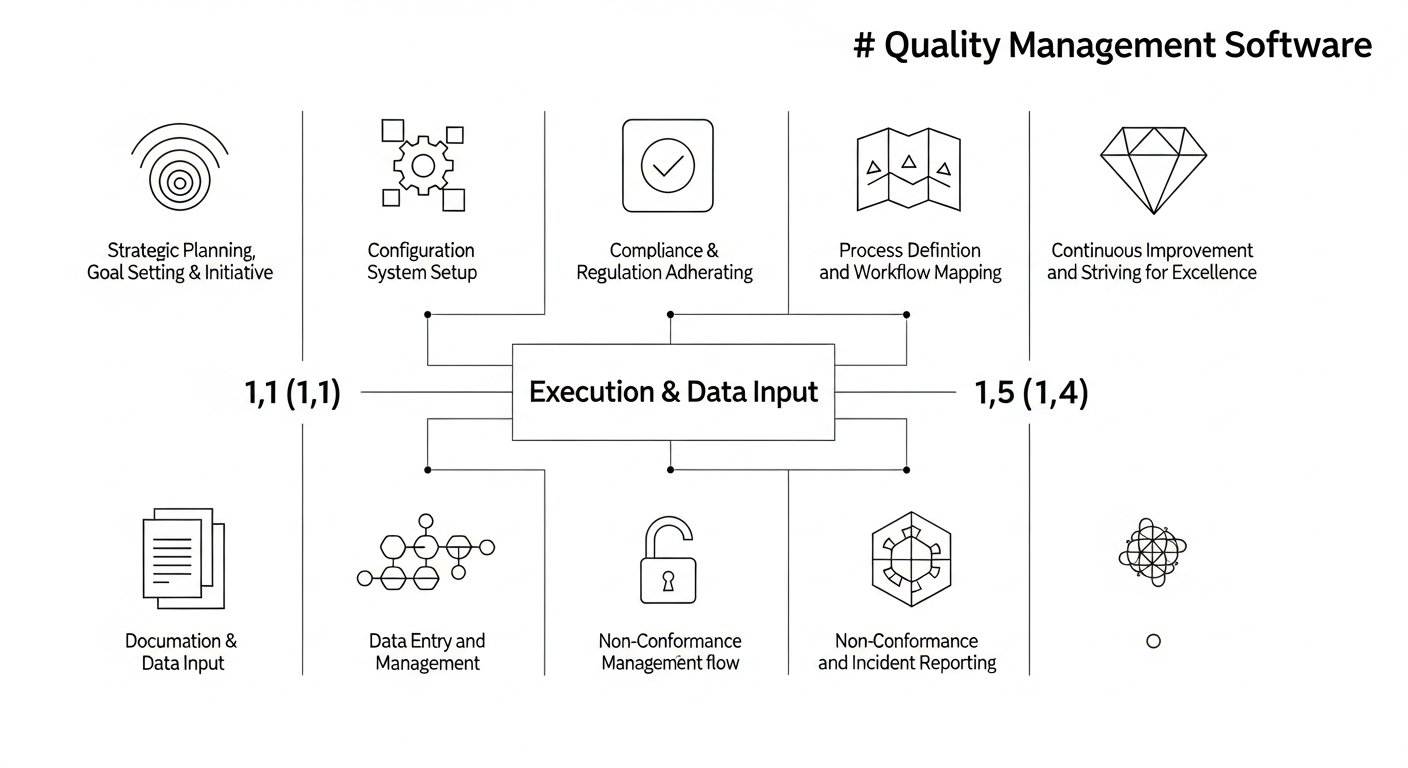
[INLINE IMAGE 2: A diagram comparing a modular EQM architecture featuring Document Control, CAPA, and SPC integrated with a central manufacturing execution system.]
3. The Tangible Benefits of Implementing Digital QMS in Production Environments
Transitioning to a digital compliance framework yields measurable improvements across operational efficiency, risk mitigation, and bottom-line profitability. Manufacturers operating in high-stakes sectors, such as automotive or pharmaceuticals, experience the most dramatic transformations because the cost of poor quality in these industries is exponentially higher. A study by LNS Research (2026) indicates that digital quality system adoption increases First-Pass Yield (FPY) by an average of 18% within the first two years of deployment.
Consider a Tier-1 automotive supplier manufacturing brake calipers. By implementing a digitized control environment, the engineering team detects a micro-fracture trend early because predictive algorithms trigger an automated alert. This allows for immediate die casting temperature calibration before 10,000 defective units are poured. Predictive alerts prevent massive scrap runs because the system continuously analyzes machine tolerances in real-time against historical baseline data, catching thermal or dimensional drifts before they violate stringent control limits. This drastically reduces the volume of automated defect detection processes required at the end of the line.
Furthermore, digitized training modules ensure operational continuity. When an updated safety protocol is released, the system automatically pushes a required acknowledgment form to every relevant operator’s tablet. The line supervisor immediately sees a dashboard highlighting exactly who has read the new protocol and who requires follow-up, entirely eliminating the risk of uncertified personnel operating heavy machinery and ensuring compliance is maintained without halting daily operations.
4. How Do You Execute a Seamless System Implementation on the Factory Floor?

Deploying an enterprise-grade compliance platform is a major operational undertaking that requires meticulous planning. The technical installation is often the easiest part; the true challenge lies in change management and workflow alignment. Successful rollouts avoid the ‘big bang’ approach, opting instead for phased deployments that allow operators to acclimate to new digital interfaces progressively, reducing cognitive overload and preventing sudden production bottlenecks.
A Strategic Implementation Roadmap
- Process Mapping and Gap Analysis: Before selecting software, map every existing quality process. Identify bottlenecks in your current paper-based workflows. You cannot automate a broken process; digitizing inefficiency only makes it fail faster.
- Data Migration and Cleansing: Migrating 15 years of legacy ISO SOPs into a new digital environment requires aggressive data cleansing. Archive obsolete documents and ensure all migrated files are correctly tagged with metadata for future searchability.
- System Integration (ERP/MES): The quality platform must communicate with your leading industrial automation platforms. If your quality system does not know what your ERP is scheduling, you will face massive reconciliation issues.
- Validation (IQ/OQ/PQ): For regulated industries, the software must undergo Installation Qualification (IQ), Operational Qualification (OQ), and Performance Qualification (PQ) to prove to auditors that the system performs exactly as intended under load.
- Role-Based User Training: Do not train an assembly line worker on the CAPA administrative backend. Train them specifically on the digital forms they will use daily.
Deloitte’s 2026 manufacturing technology review notes that 70% of digital transformations stall due to poor user adoption, not technical flaws. A phased rollout—perhaps starting exclusively with the Document Control module before introducing complex SPC charting—allows the workforce to build confidence in the new tooling.
[INLINE IMAGE 4: Flowchart showing the phased rollout of a digital quality system across a factory floor, from data mapping and migration to user validation and training.]
5. Key Selection Criteria for Digital Quality Solutions in Industrial Settings
Selecting the right platform dictates the long-term success of your compliance strategy. An off-the-shelf software designed for a retail supply chain will fundamentally fail to address the nuance of a discrete manufacturing environment. Plant managers must evaluate vendors based on industry-specific capabilities, integration readiness, and the true Total Cost of Ownership (TCO), which includes implementation hours, specialized training, and ongoing technical support.
Evaluating Vendor Capabilities
| Selection Criterion | Description | Importance for Manufacturing | Example Question to Ask Vendors |
|---|---|---|---|
| Integration Readiness | Ability to connect with legacy MES/ERP architectures via API. | Critical | Do you offer native bidirectional integration with SAP or Oracle manufacturing modules? |
| Industry-Specific Compliance | Pre-configured templates for ISO 9001, AS9100, or FDA 21 CFR Part 11. | Critical | Can your system enforce FDA-compliant electronic signatures out of the box? |
| Mobile Accessibility | Shop floor access via tablets or ruggedized handheld devices. | High | Does the mobile application function offline if Wi-Fi drops on the factory floor? |
| Scalability | The system’s capacity to handle increased data loads as facilities expand. | Moderate to High | How does your licensing model adapt if we acquire a new plant and double our user base? |
A crucial factor often missed during procurement is how well the system integrates with connected warehouse management operations. If a batch of raw materials is flagged as non-conforming upon receipt at the loading dock, the quality platform must instantly update the warehouse inventory system to prevent those materials from being picked for production. A unified digital ecosystem ensures that quality data dictates material movement, not just historical reporting.
6. Traditional Paper-Based Control Versus Automated Digital Frameworks
Despite the clear advantages of digital ecosystems, a surprising number of mid-market manufacturers still rely on hybrid or entirely paper-based compliance workflows. The limitations of physical documentation become glaringly obvious during critical defect investigations or multi-site audits. Paper systems inherently fail to scale because the data remains unstructured, meaning any attempt at trend analysis requires hours of manual aggregation, which is mathematically prone to human error.
Comparing Operational Frameworks
| Operational Aspect | Paper-Based / Hybrid Approaches | Automated Digital Frameworks | Impact on Manufacturing Efficiency |
|---|---|---|---|
| Data Accuracy | Prone to transcription errors and lost documentation. | Enforced data validation rules; automated instrument reading. | Eliminates rework caused by misread specifications. |
| Visibility & Reporting | Siloed in filing cabinets; requires manual data entry to chart. | Real-time dashboarding with drill-down capabilities. | Enables immediate course correction during active shifts. |
| Version Control | High risk of operators using outdated, physical SOP copies. | Centralized repository; obsolete documents instantly revoked. | Guarantees 100% compliance with current engineering standards. |
Imagine the process of archiving physical compliance binders for a medical device that requires retention records for 15 years. The physical storage space alone incurs massive overhead, let alone the environmental controls required to prevent document degradation. Transitioning to a digital landscape resolves these physical constraints while simultaneously turning historical data into a searchable, predictive asset. According to a 2026 McKinsey operations analysis, fully digitized quality workflows reduce the cost of poor quality (COPQ) by up to 25% within three years of stabilization.
Ultimately, selecting and deploying the right Quality Management Software transforms compliance from a reactive, cost-center necessity into a proactive driver of operational excellence. As global supply chains grow more complex and regulatory bodies tighten their oversight, embracing these digital ecosystems is no longer optional for manufacturers aiming to maintain a competitive edge. [PILLAR LINK: Quality Management & Standards]
Sources & References
- Gartner, Inc. (2026). “Magic Quadrant for Enterprise Quality Management Systems.” Gartner Research.
- Aberdeen Group. (2026). “The Cost of Quality: Moving from Reactive to Proactive Operations in Manufacturing.”
- LNS Research. (2026). “The Digital Quality Management Benchmark Report: Yield and ROI Metrics.”
- Deloitte. (2026). “Digital Transformation in the Factory: Overcoming the User Adoption Hurdle.” Deloitte Insights.
- McKinsey & Company. (2026). “Industry 4.0: Digitizing the Shop Floor for Sustainable Quality Gains.”